

Is Kilimanjaro in Moshi? Understanding the Location Relationship

Is Kilimanjaro in Moshi? The short answer is no — but the two are closely linked. Mount Kilimanjaro is located in the Kilimanjaro Region of northeastern Tanzania, roughly 30 km from Moshi town. Moshi is the regional capital, sitting at the base of the mountain. It is not the same place as Kilimanjaro, but it is the closest major town to it.
Book Your Transfer
Fill in your details and we'll confirm your booking on WhatsApp.
Here is a quick breakdown:
| Moshi | Mount Kilimanjaro | |
|---|---|---|
| Type | Town / Municipality | Mountain / National Park |
| Elevation | ~890 m (2,900 ft) | 5,895 m (19,341 ft) at Uhuru Peak |
| Location | Kilimanjaro Region capital | Kilimanjaro Region, Tanzania |
| Distance apart | — | ~30 km from Moshi town center |
| Administrative unit | Moshi Municipality | Kilimanjaro National Park |
Moshi is often confused with Kilimanjaro because the region, the mountain, the airport, and the town all share the same name. But they are distinct places. The mountain sits inside Kilimanjaro National Park, not within Moshi’s municipal boundaries.
What makes Moshi so important is its role as the primary staging town for climbers. All major hiking routes up Kilimanjaro depart from gates that are a short drive from Moshi. Most climbers fly into Kilimanjaro International Airport (JRO) and head straight to Moshi to prepare.
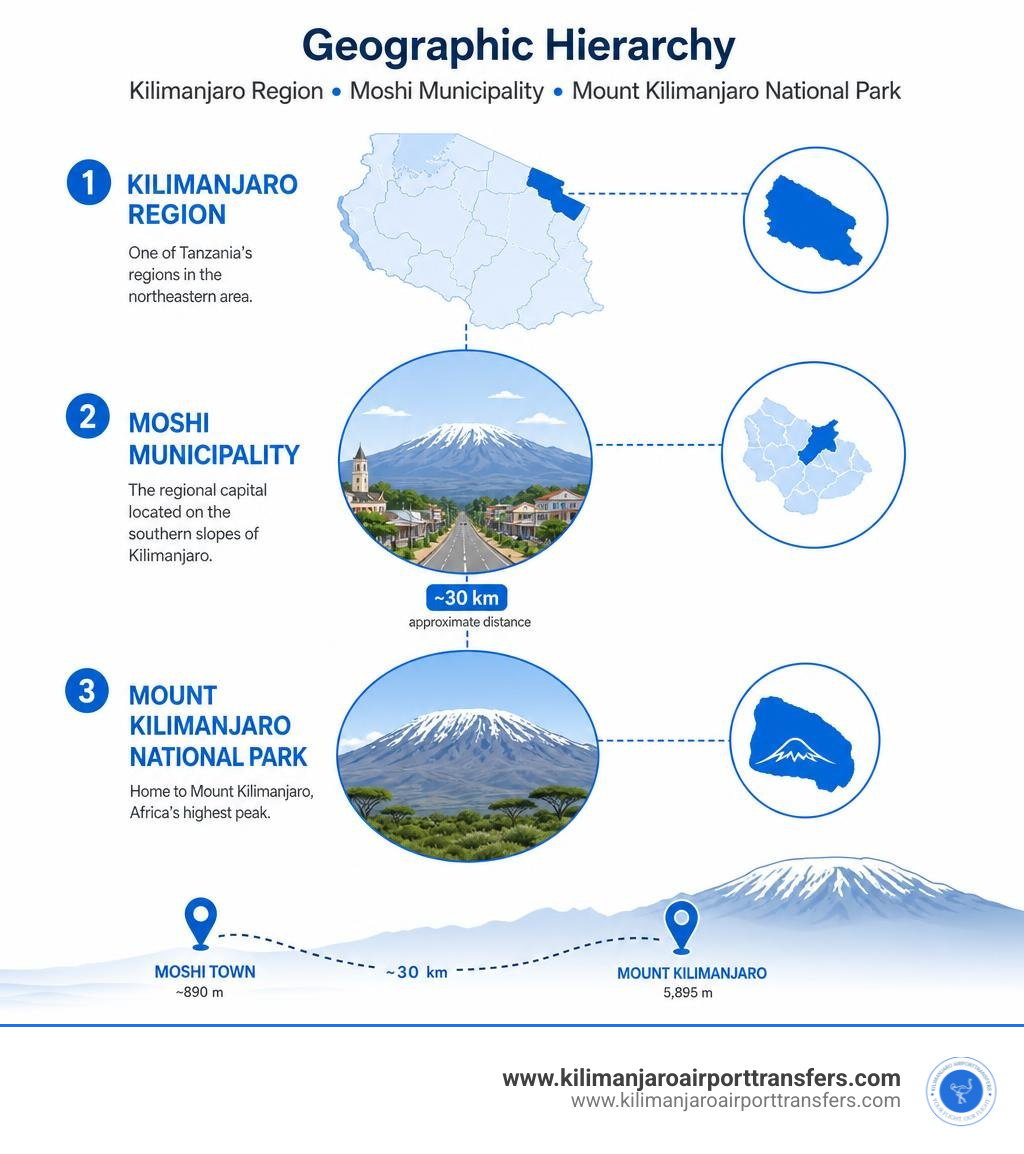
Is Kilimanjaro in Moshi? Geography and Distance
When people ask whether is kilimanjaro in moshi, they are usually trying to figure out where they should stay, land, and arrange their trekking logistics. Geographically speaking, Mount Kilimanjaro and Moshi town are two distinct entities separated by roughly 30 kilometers (18.6 miles).
Moshi is situated on the low-altitude southern slopes of the mountain at an elevation of approximately 890 meters (2,899 feet) above sea level. Meanwhile, the snow-capped peak of Mount Kilimanjaro—known as Uhuru Peak—soars to a dramatic 5,895 meters (19,341 feet). This creates an immense elevation change of over 5,000 meters in a relatively short spatial footprint!
Administratively, both the mountain and the town reside within the Kilimanjaro Region of northeastern Tanzania. The region covers approximately 13,250 square kilometers (5,120 square miles) and stretches all the way to the border with neighboring Kenya. Within this regional structure, Moshi serves as the official administrative capital and commercial engine, while Mount Kilimanjaro dominates the natural landscape as a protected UNESCO World Heritage Site.
Understanding this geographic distance is critical for travel planning. While you cannot simply walk out of a café in downtown Moshi and immediately find yourself on the mountain slopes, the drive from the municipal center to the closest entry gates of Kilimanjaro National Park takes anywhere from 45 to 60 minutes.
Is Kilimanjaro in Moshi Municipality or Region?
To understand how the administrative lines are drawn, it helps to separate the municipality from the surrounding region:
- Moshi Municipality: Spanning roughly 59 square kilometers (23 square miles), Moshi is actually the smallest municipality in Tanzania by land area, despite holding a vibrant population of over 200,000 residents. The municipality consists of 21 urban and suburban wards, such as Shanty Town, Sekou Toure, and Kiboriloni. None of the mountain’s high-altitude slopes or hiking trails fall inside Moshi Municipality.
- Kilimanjaro Region: This is the broader provincial territory containing six administrative districts, including Moshi Urban, Moshi Rural, Hai, Rombo, Mwanga, and Same.
- Kilimanjaro National Park: Established in 1973, the national park covers 1,688 square kilometers (652 square miles). The park encompasses the entire mountain above the tree line as well as the montane forest belt. It is managed by the Tanzania National Parks Authority (TANAPA), completely separate from Moshi’s municipal government.
Historically, the fertile volcanic foothills surrounding Moshi and the lower slopes of the mountain have been home to the Chagga people for over 400 years. The Chagga established sophisticated agricultural practices, including an ingenious traditional irrigation system called mfongo to channel mountain stream waters into banana and Arabica coffee farms. Thus, while Mount Kilimanjaro geography places the physical peak inside the national park, the human and cultural heart of the region resides firmly in Moshi.
Common Misconceptions: Is Kilimanjaro in Moshi or a Separate Place?
It is easy to see why so many international travelers get confused about whether is kilimanjaro in moshi or if they are two names for the same location. Several factors contribute to this common mix-up:
- Shared Naming Conventions: You have the mountain (Mount Kilimanjaro), the administrative province (Kilimanjaro Region), the international gateway, and local businesses all using the name “Kilimanjaro.”
- The Kenya Border Misconception: Countless postcards feature iconic photos of wild elephants in Kenya’s Amboseli National Park with the giant snow-capped peak of Kilimanjaro towering in the background. This leads many to believe the mountain is in Kenya. In reality, while Mount Kilimanjaro is easily visible across the border, the entire mountain, all of its climbing routes, and the town of Moshi lie 100% inside Tanzania.
- Basecamp Terminology: Guidebooks often refer to Moshi as “Kilimanjaro Basecamp.” First-time visitors sometimes assume this means the town sits right on the hiking trail, rather than being a separate urban area a short drive away.
To clear up any lingering confusion, let us examine how the municipality and the mountain compare side-by-side:
| Geographic & Administrative Feature | Moshi Municipality | Mount Kilimanjaro |
|---|---|---|
| Primary Classification | Urban Town & Regional Capital | Stratovolcano & National Park |
| Land Area | ~59 km² (23 sq mi) | ~1,688 km² (652 sq mi) |
| Governance Body | Moshi Municipal Council | TANAPA (National Parks Authority) |
| Primary Economic Activity | Commerce, Tourism, Coffee Trade | Eco-Tourism, Conservation, Research |
| Human Habitat | Permanent residential neighborhoods | Protected wilderness (No permanent homes) |
| Access Requirements | Free public movement | Mandatory park permits & certified guides |
| Volcanic Activity | Non-volcanic lowland basin | Dormant volcano (Kibo, Mawenzi, Shira) |
When you are planning your adventure, keep in mind that Moshi is where you eat, sleep, and meet your guides, while Mount Kilimanjaro is where you do the actual high-altitude trekking.
Why Moshi Is the Gateway to Mount Kilimanjaro
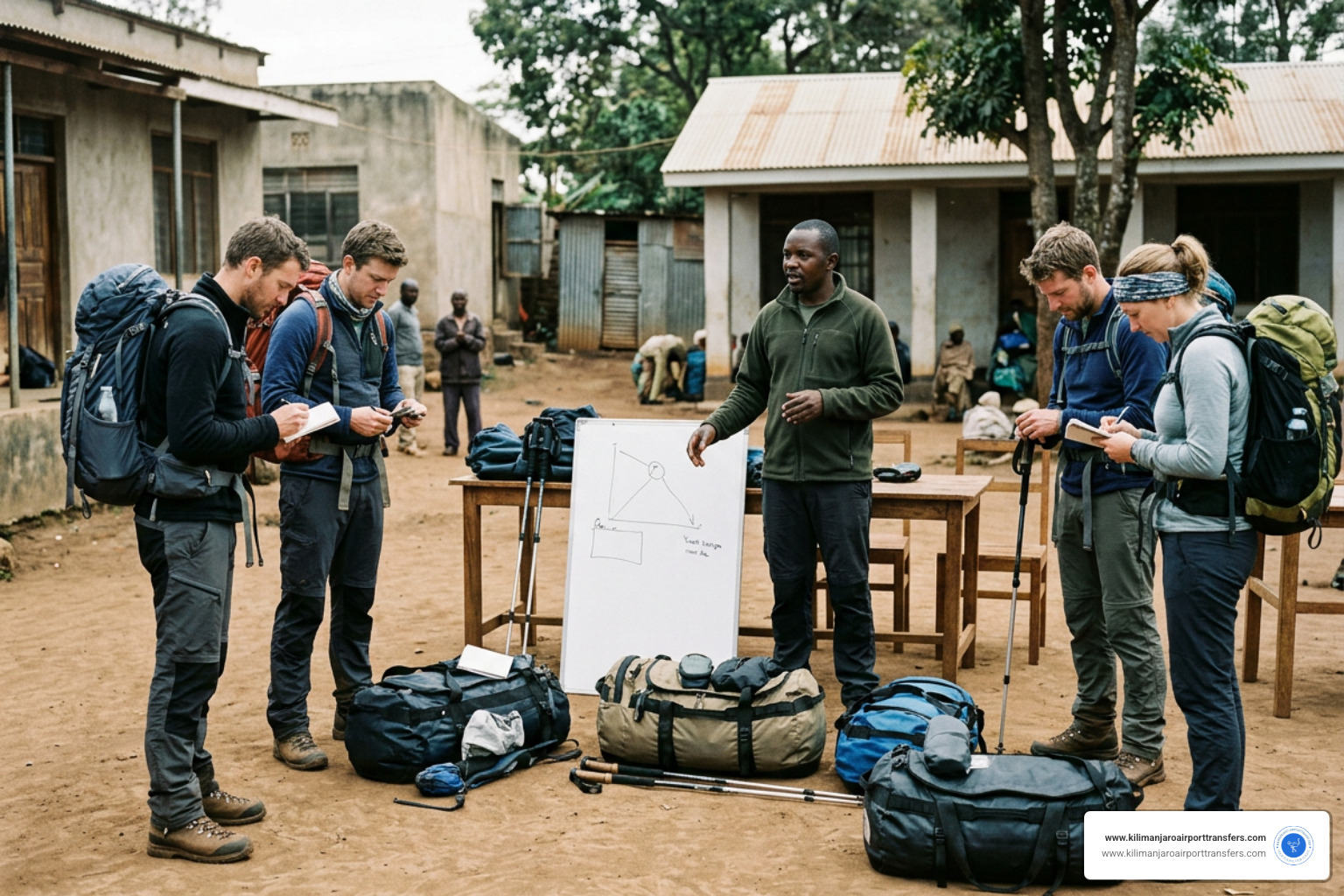
While Moshi and Mount Kilimanjaro are geographically distinct, Moshi is universally recognized as the premier gateway for anyone attempting Africa’s highest summit. There is a reason almost every major trekking expedition staging takes place right here in Moshi.
For decades, Moshi has served as the operational backbone of the Tanzanian trekking industry. The town is packed with licensed tour operators, specialized mountain gear rental shops, comfortable pre-climb hotels, and experienced local guides. When you arrive in Moshi, your pre-climb itinerary typically involves a detailed safety briefing, a thorough pulse-oximeter health check, and a mandatory gear inspection with your lead guide. If you are missing crucial equipment—such as a zero-degree sleeping bag, trekking poles, or waterproof gaiters—you can easily rent high-quality equipment right in town before setting off.
Beyond pure mechanics and logistics, Moshi offers a gentle, relaxing environment to shake off jet lag. Sitting at an altitude of 890 meters, it provides a warm tropical climate that allows travelers to rest up comfortably. You can spend your pre-climb day touring local Chagga coffee smallholdings, taking a refreshing dip at Materuni Waterfalls, or sampling fresh Arabica brews at local cafés. Many travelers find that taking a day or two to explore Moshi creates a wonderful cultural foundation before tackling the physical challenge of the mountain.
If you are debating where to base your pre-climb stay, evaluating the pros and cons of staying in Arusha versus Moshi is a great step. While Arusha is a larger commercial hub favored for western safari circuits, Moshi is significantly closer to the primary southern and eastern climbing gates, making transit on your trekking morning far shorter and less stressful.
Visibility: Can You See Mount Kilimanjaro from Moshi?
Yes, you can absolutely see Mount Kilimanjaro from Moshi—and on a clear day, the view is breathtaking! Standing in downtown Moshi and looking north, the giant mass of Kibo crater and its glittering glaciers seem to float right above the palm trees and rooftops.
However, viewing conditions depend heavily on the time of day and the time of year:
- Time of Day: The mountain is most visible in the early morning (between 6:00 AM and 8:30 AM) before the sun warms the lowland plains. As heat rises off the valley floor during late morning and afternoon, thick cloud cover often wraps around the lower slopes and conceals the summit. By late afternoon or sunset, clouds frequently dissipate, offering a stunning evening view of the snow caps glowing in orange and pink twilight.
- Dry Seasons (Best Visibility): During the primary dry seasons—from January to March and June to October—clear blue skies are common, providing frequent, crisp views of Uhuru Peak directly from hotel balconies in neighborhoods like Shanty Town.
- Rainy Seasons (Limited Visibility): During the heavy rainy season (March through May) and the shorter rains (November to December), heavy cloud layers and rain clouds obscure the mountain for days at a time. You might know a 5,895-meter volcano is sitting 30 km away, but all you will see from Moshi town is a dense wall of gray clouds!
Interestingly, local legend says that the very name Moshi—which means “smoke” in Swahili—was inspired by the persistent ring of clouds and mist that wraps around Mount Kilimanjaro’s base, resembling volcanic smoke rising into the sky.
Getting from Moshi to Kilimanjaro National Park Gates
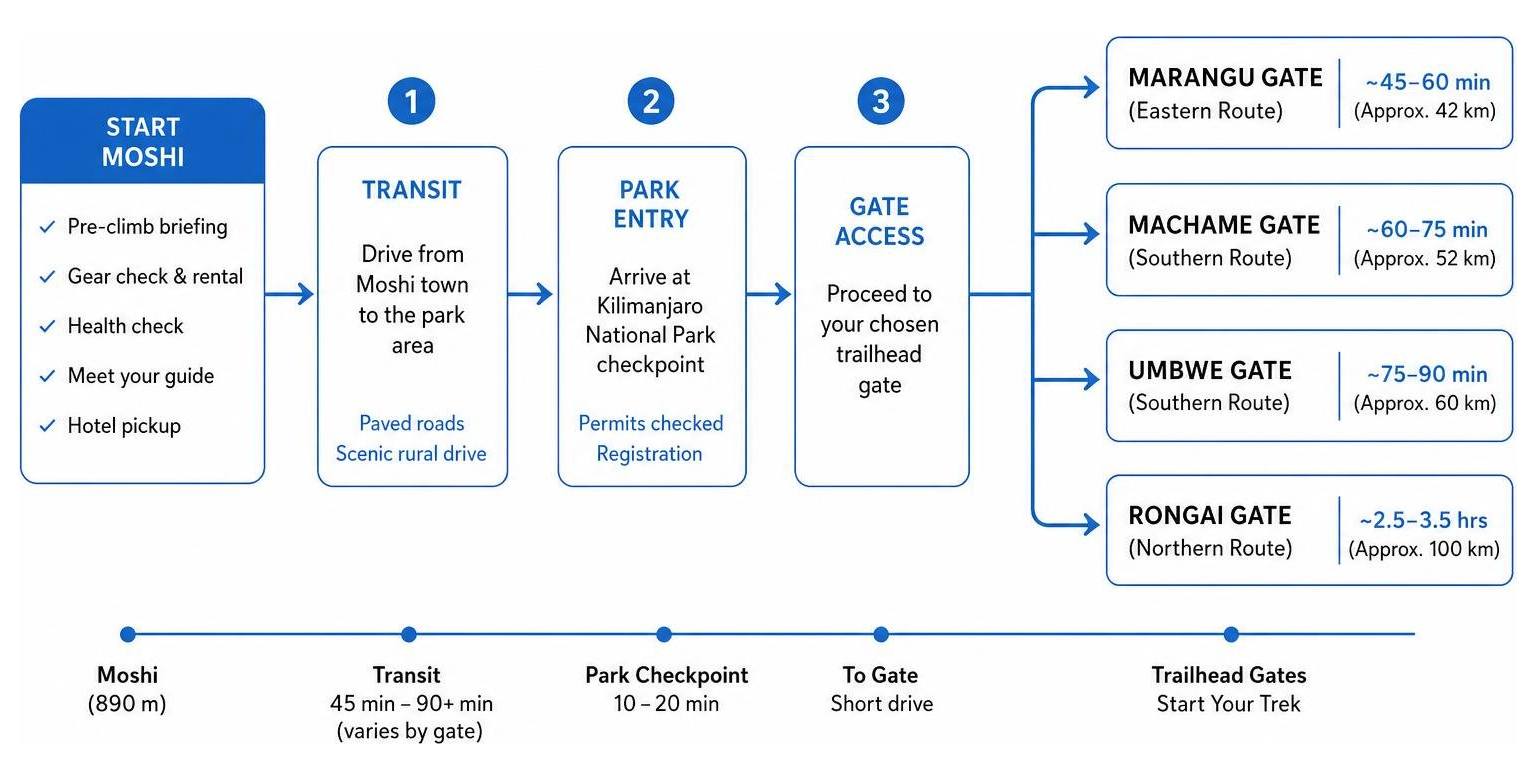
Once your pre-climb briefings and equipment checks are finished in Moshi, your actual trekking journey begins with a road transfer from your hotel to one of the official Kilimanjaro National Park entry gates.
Because Moshi sits directly south of the mountain, driving times to the southern and eastern gates are remarkably fast and convenient. Here is a breakdown of average transit times from Moshi town center to the primary trailhead gates:
- Marangu Gate (Eastern Route): ~45 to 60 minutes drive (Approx. 42 km). This is the smoothest and closest drive from Moshi, taking you through lush Chagga villages along paved roads.
- Machame Gate (Southwestern Route): ~45 to 60 minutes drive (Approx. 40 km). A scenic drive winding uphill through banana plantations and coffee farms to the rainforest canopy.
- Umbwe Gate (Southern Route): ~50 to 60 minutes drive (Approx. 38 km). Takes you directly to the steepest south-face trailhead.
- Lemosho / Londorossi Gate (Western Routes): ~2 to 2.5 hours drive. Requires traveling around the western base of the mountain through Sanya Juu.
- Rongai Gate (Northern Route near Kenya Border): ~3 hours drive. Involves driving around the eastern side of the mountain toward the drier northern slopes.
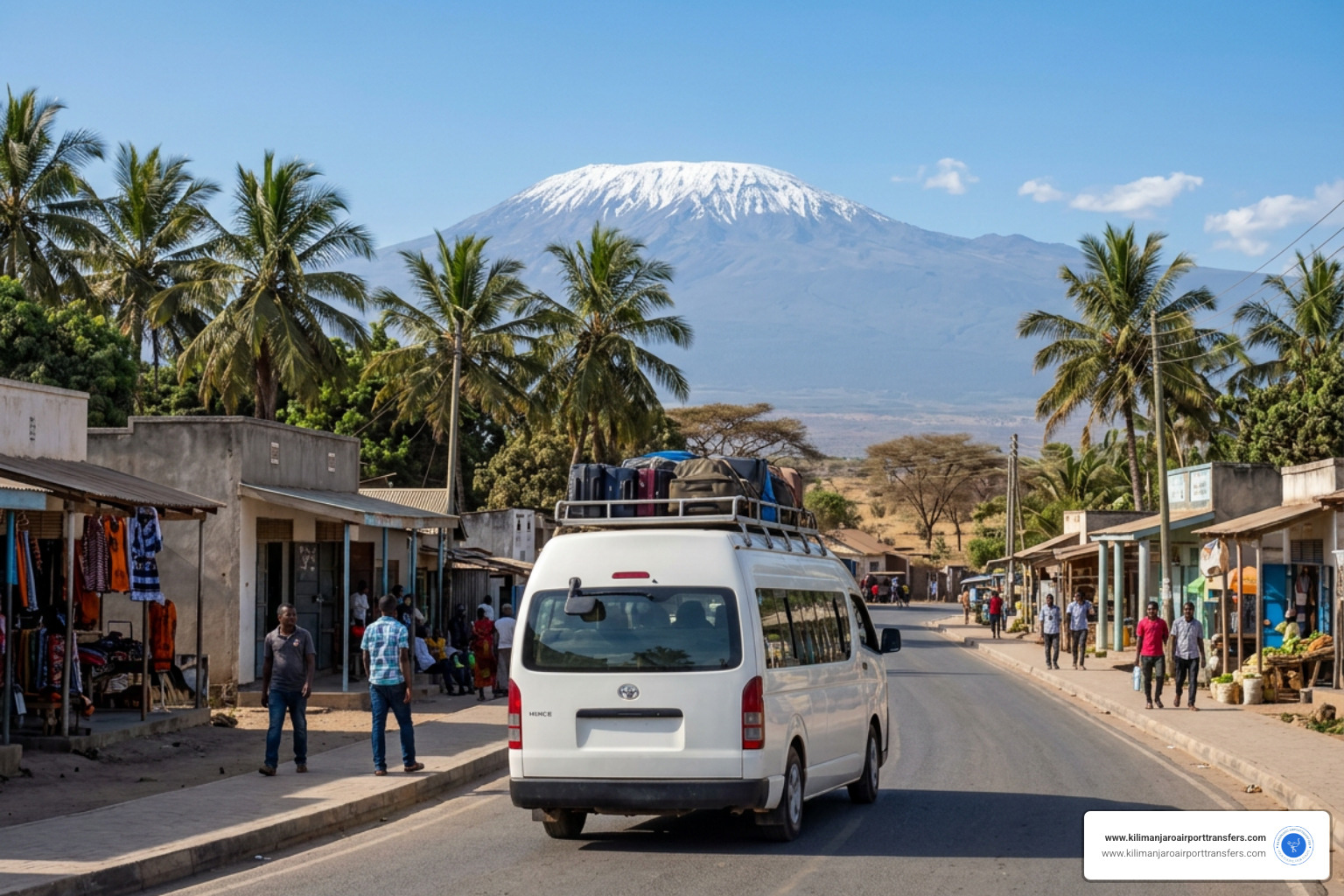
To ensure a seamless start to your trip, arranging reliable private transport ahead of time is key. Most international travelers land at Kilimanjaro International Airport (JRO). From the airport terminals, booking a seamless transfer via Kilimanjaro Airport to Moshi ensures you are met by a professional driver upon landing and whisked straight to your hotel in Moshi.
If you are curious about transfer distances and logistics across the region, you can check our detailed breakdown of Transportation from Kilimanjaro Airport to Moshi. Knowing your transit timelines in advance takes all the stress out of your travel day so you can focus entirely on your upcoming summit attempt.
If you are planning a broader Tanzanian itinerary that includes western safaris or domestic connections out of Arusha, you can also review How to Get from Kilimanjaro Airport to Arusha or arrange direct transit from Kilimanjaro Airport to Arusha.
Frequently Asked Questions About Moshi and Kilimanjaro
What is the exact distance between Moshi town center and Mount Kilimanjaro?
The straight-line distance from Moshi town center to the summit of Mount Kilimanjaro (Uhuru Peak) is approximately 30 kilometers (18.6 miles). However, because you cannot drive up the mountain wall, driving distances vary depending on which national park gate you are heading to.
For instance, driving from downtown Moshi to Marangu Gate covers about 42 km of paved road, taking around 45 to 60 minutes. Driving to Machame Gate covers roughly 40 km and takes about 50 minutes. The journey takes you out of the urban lowland plain, through the fertile agricultural belt of the Chagga foothills, and directly to the edge of the protected high-altitude rainforest.
Do you fly into Moshi or Kilimanjaro International Airport (JRO)?
When traveling from overseas, you should fly into Kilimanjaro International Airport (JRO).
Kilimanjaro International Airport is the region’s main international hub, situated approximately 40 km (25 miles) west of Moshi town center—roughly a 40 to 50-minute drive away. Major international airlines like KLM, Qatar Airways, Ethiopian Airlines, and Turkish Airlines fly directly into JRO.
It is worth noting that Moshi does have a small air strip called Moshi Airport (MYW) located right inside the municipality. However, this small facility handles only domestic charters, light private aircraft, and specialized high-altitude helicopter rescue operations managed for Mount Kilimanjaro emergencies. It does not accommodate commercial international flights.
How many days should you stay in Moshi before climbing Kilimanjaro?
We strongly recommend spending at least 1 to 2 full days (2 nights) in Moshi prior to starting your mountain climb.
Here is why that buffer time is so valuable:
- Flight Delay Protection: International flights can get delayed, and long-distance luggage sometimes takes an extra day to arrive. Having a buffer day in Moshi prevents you from missing your scheduled mountain departure.
- Rest and Jet Lag Recovery: Flying across multiple time zones is exhausting. Resting comfortably at an altitude of 890 meters allows your body to recover, rehydrate, and settle before you begin pushing into oxygen-thin environments.
- Gear Inspection & Rentals: You need dedicated time to meet your head guide, review safety procedures, and try on rental gear (such as heavy winter jackets, boots, or sleeping bags) to ensure everything fits properly.
- Local Cultural Exploration: A stay in Moshi gives you time to take a day trip to Materuni Waterfalls, enjoy a local coffee tour, or relax at Rundugai (Kikuletwa) Hot Springs.
Conclusion
So, is kilimanjaro in moshi? As we have explored, Mount Kilimanjaro is not located inside the town of Moshi, but the two share a powerful, inseparable bond. Moshi sits proudly at the foot of the mountain as the capital of the Kilimanjaro Region, offering the ultimate staging ground, gear hub, and cultural capital for travelers from across the globe.
Understanding the geographic relationship between Moshi town, Kilimanjaro National Park, and Kilimanjaro International Airport makes planning your Tanzanian adventure effortless. By establishing Moshi as your pre-climb basecamp, you give yourself the best possible environment to rest, prepare gear, meet your guides, and soak in warm Swahili hospitality before setting foot on Africa’s rooftop.
When you land at JRO, let us handle your airport transfer logistics so you can arrive in Moshi relaxed and ready for the climb of a lifetime. Book your reliable, comfortable ride today with Kilimanjaro Airport Transfers and kick off your Kilimanjaro journey with absolute peace of mind!